Concept vs. Execution: why strong conceptual creativity makes the difference
Weak concept with perfect execution is still weak
You’ve seen a technically flawless video — perfect colors, smooth animation, impeccable timing — but you feel… indifferent.
And you’ve also seen a technically modest video that makes you stop, think, and share.
The difference isn’t rendering. It’s the idea.
Motion design is 50% concept and 50% execution. Most professionals focus only on the second half.
What is a strong creative concept?
A concept is the reason that video exists. It’s not what you see. It’s the idea behind what you see.
Examples:
- Weak concept: “Make a product video” → Result: boring product footage
- Strong concept: “Show how the product solves a problem the customer didn’t even know they had” → Result: emotionally resonant narrative
Or:
- Weak concept: “Animate the company logo” → Result: elegantly spinning logo
- Strong concept: “Tell the brand’s story through the visual evolution of the logo” → Result: narrative showing evolution, mission, identity
Strong concept makes execution worthwhile. Without concept, execution is just empty technique.
Perfect execution without concept is like building a castle on sand
You can have the best composer in the city scoring your video. Perfect color harmony. Impeccable timing. Impressive 3D effects.
But if nobody understands why they’re watching it, nobody stays.
Perfect technical execution without clear concept is like an actor brilliantly performing in a poorly-written movie. Impressive for 30 seconds, then exhausting.
Strong conceptual creativity is different. A genuine idea grips because it communicates. Because it touches something true.
How strong conceptual ideas are born
It’s not mystical inspiration. It’s process.
A strong concept comes from asking the right questions:
- What’s the client’s real problem? (Not “they want a video.” What pain will the video solve?)
- What emotion do we want to generate? (Urgency? Trust? Curiosity? Joy?)
- How do we tell this in a way nobody’s seen before? (What’s the unique angle?)
- What truth backs this story? (Why will people believe it?)
When you answer these questions well, the concept emerges naturally.
Strong vs. weak concept in the real world
Fashion e-commerce:
- Weak: Show clothes in different colors and styles
- Strong: Show how each piece transforms the confidence of whoever wears it (psychological before/after, not just visual)
SaaS B2B:
- Weak: List software features in order
- Strong: Show the chaos that exists today (without the software) and the clarity that comes (with it) in 30 seconds
Personal brand:
- Weak: Display portfolio of past work
- Strong: Tell why you do what you do and what difference it made for clients
Strong concept isn’t in better animation. It’s in telling a story that matters.
The hierarchy: idea comes first
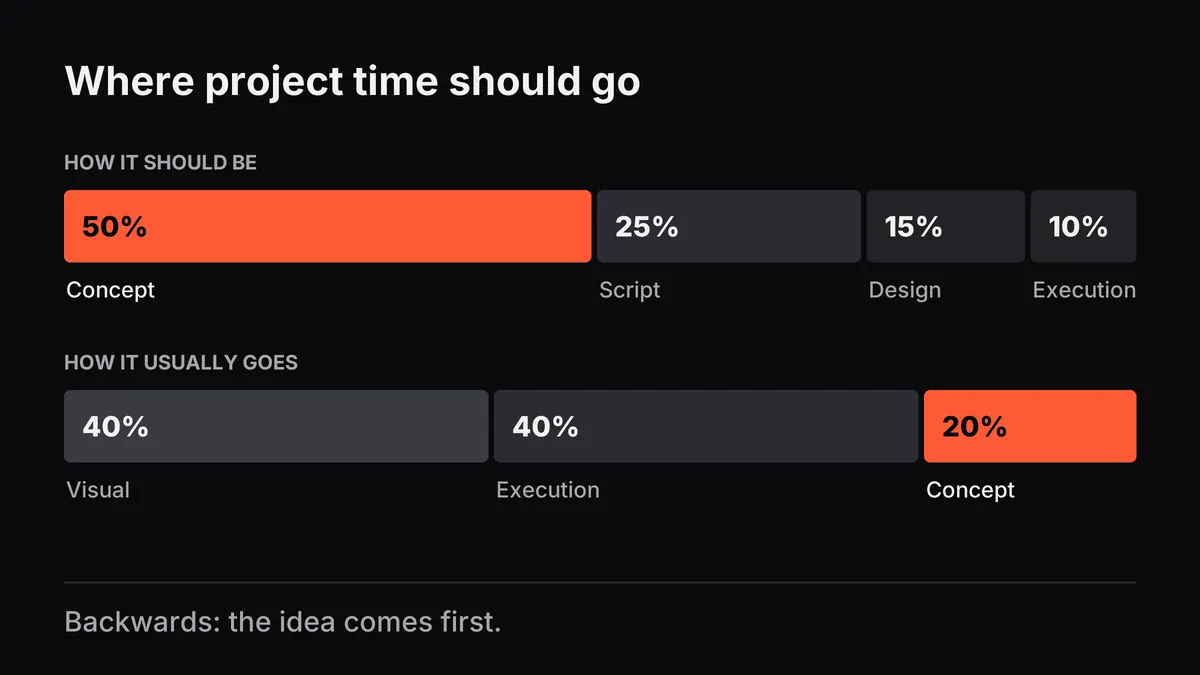
When starting a video project, the timeline should be:
- Concept/Idea (50% of time)
- Script/Structure (25% of time)
- Design/Visual (15% of time)
- Technical execution (10% of time)
But in practice, many do:
- Visual/Aesthetics (40%)
- Technical execution (40%)
- Concept (20%)
Backwards.
Why big agencies win pitches against freelancers
The difference usually isn’t technology. It’s creative process.
Big agencies spend hours on brainstorming and concept refinement before touching any tool. A freelancer sometimes skips this and goes straight to After Effects.
Result? The agency delivers a video that works because it has conceptual foundation. Freelancer delivers a pretty video nobody shares.
Try this method next time
Before opening any video tool:
- Write the core idea in one sentence (if it fits)
- Write why this idea matters to the client
- Write what emotion you want people to feel
- Only then, start designing/animating
I bet the video comes out 10x better.
What’s the most creative concept you’ve worked on? What made it memorable?