Why motion design boosts engagement on social media
Your feed isn’t static — and neither should your videos be
You’re scrolling through Instagram, LinkedIn, or TikTok. Among ten static image posts, one video whips by. Your attention snaps to it. You stop. You watch.
That’s not coincidence. That’s neuroscience.
Our brains evolved to notice movement — it’s a survival mechanism that goes back millennia. Something moving in your peripheral vision? Worth paying attention to.
Social platforms know this. That’s why algorithms favor video. That’s why motion design works.
What is motion design (and why it’s more than just “moving things”)
Motion design is more than making objects move. It’s using movement with purpose — to guide the eye, tell a story, convey emotion, create urgency.
Static text says “click here.” Well-crafted animation shows why you should click.
A series of product images shows what it looks like. A video shows how it works, what problem it solves, and why you need it.
Movement communicates. And clear communication drives engagement.
The numbers don’t lie: the impact of motion
The stats are undeniable:
- Videos generate 10x more engagement than static images on Instagram
- Video posts on LinkedIn receive 3x more comments than text posts
- Motion content reduces bounce rate on websites by up to 80%
- Video ads have conversion rates 2-3x higher than static banners
Why? Because movement keeps attention longer. And the longer someone engages with your content, the more likely they are to interact — comment, share, convert.
The trick: purposeful movement, not just speed
Anyone can create fast animation. What separates quality motion design is intention.
Every movement should have a reason:
- An arrow moving to guide focus to the CTA
- Numbers increasing to show growth
- Colors changing to highlight important info
- Smooth transitions that keep the viewer following the narrative
Bad motion design is chaotic — too many effects competing for attention. Good motion design is crystal clear — each movement communicates one thing.
And when there’s clarity? Engagement follows.
From the studio to metrics: the formula that works
You know that 15-second video of a product being disassembled and reassembled in fast-motion? Or that animated GIF explaining a complex concept in 3 seconds?
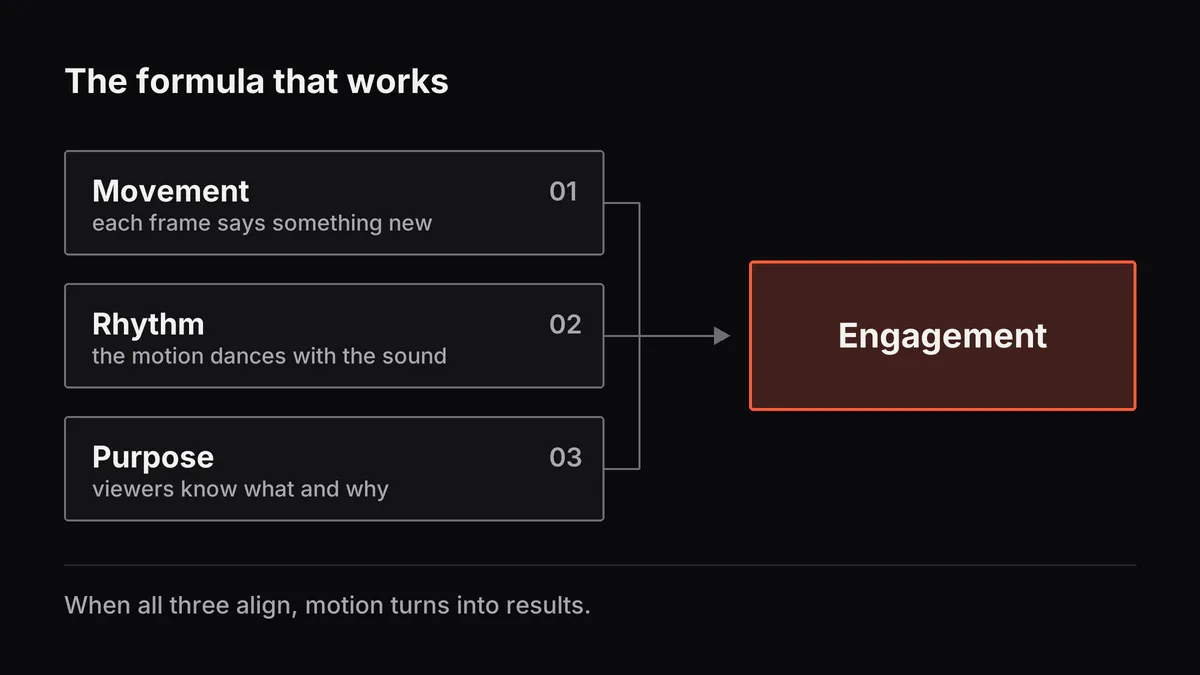
Those work because they combine three elements:
- Intelligent movement — each frame communicates something new
- Rhythm synced to music/audio — the movement dances with the sound
- Clear purpose — the viewer knows what they’re seeing and why
When those three elements align, you have an engagement formula.
Why brands using motion grow faster
If you’re competing for attention in a saturated feed, motion design isn’t a “nice to have.” It’s essential.
Companies investing in video motion for social media see:
- Increased reach (algorithms favor video)
- More watch time (movement captures attention)
- Higher conversion rates (clarity communicates)
- Greater memorability (brains retain motion better)
A brand posting one static image loses to one posting a solid 10-second video. Always.
What to do now
If your content is still 100% static, it’s time to change:
- Transform images into short videos (3-15 seconds)
- Use motion to highlight key elements
- Sync movement with audio/music
- Test different rhythms and track what your audience engages with
Motion isn’t an extra. It’s the language social platforms speak best.
Have you noticed your motion-based videos outperform your static images? Share your experience — which types of movement work best for your business?